about us
distribution
contact
news flash
ITA
login
sign up
(
0
)
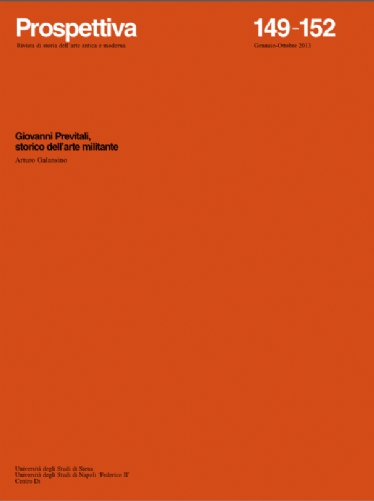
PROSPETTIVA 149-152 (January - October 2013). Giovanni Previtali, storico dell'arte militante
Arturo Galansino
pp. 362
year 2014
price: € 100
add to cart
Giovanni Previtali was born in Florence on 4 March 1934 and died in Rome on 3 February 1988, in his mid-fifties. A pupil of Roberto Longhi, and known especially for his work on the Italian Trecento, Previtali attempted to reinvigorate traditional connoisseurship with new methodologies. His scholarly activity covered a remarkable variety of interests, consistently pursued throughout his career: from the "aree minori" to the study of artistic literature and the history of criticism, from methodological reflection to cultural politics. Previtali was an energetic organiser of exhibitions and of cultural and publishing initiatives, and was a constant – and frequently polemical – presence in the national press. All of his activity is to be interpreted in the light of the moral and social commitment that he believed was necessary for the art historian.
The volume is divided into three sections: an essay, an apparatus of notes and a fairly full documentary appendix (divided into correspondence and notes; unpublished articles; publishing projects). The content is based principally on the documents studied in the Previtali archives (letters, notes, projects, unpublished writings), and through them the life of the scholar is surveyed. At times reading like a novel, as well as being indispensible for an understanding of the writer and his work, this book represents a guide to thirty years of Italian art history.
The narrative begins in the mid-1950s with Previtali's arrival at the University of Florence, where he began studying under Roberto Longhi.
Longhi's world is described through the eyes of two of his students, Previtali and the young writer Fernando Tempesti. From their comments about the latest exhibitions to see and books to read, and about the political situation of the time (these were the years when Previtali was highly active in the Radical party), emerges the opposition between the Florentine school of Longhi and the Roman school of Lionello Venturi, with their different methodologies and different views of contemporary art. This opposition profoundly affected the subsequent development of art history in Italy.
Having finished his studies, and after a few attempts at finding work, in the early 1960s Previtali spent some time in Paris where he was in contact with a variety of art historians such as Vitale Bloch, Anthony Blunt, André Chastel and Michel Laclotte. On his return to Florence he started working for 'Paragone', as the editor of the periodical and as Longhi's right hand.
Two groundbreaking books by Previtali,
La fortuna dei primitivi
(1964) and
Giotto e la sua bottega
(1967), became part of the complex cultural context of the time. He embarked on an important activity as a promoter of cultural and publishing initiatives, and during the same period he was politically active in the Italian Communist Party. A stream of articles by him appeared in the national press. After the terrible destruction caused by the Florence flood of 1966, Previtali took part on Longhi's side in the heated controversies that saw Longhi pitted against Carlo Ludovico Ragghianti. Previtali also began a series of territorial studies, in particular on Umbrian sculpture (a constant motif in his work) and on the art of southern Italy.
The death of Roberto Longhi in 1970 was a symbolic turning point that altered the course of Previtali's life. His break with 'Paragone' created a lasting rift in the school of Longhi, and led to the foundation a few years later of 'Prospettiva'. This period was marked by the
engagée
Enciclopedia Feltrinelli Fischer
, a work published in Longhi's name though of avowedly Marxist inspiration, and by Previtali's growing interest in new methodologies such as Structuralism. His role as a director of Einaudi corresponded with a renewed interest in the iconology of Panofsky, in the world of the Warburg Institute (thanks to his relations with Ernst Gombrich) and in the anthropological theories of George Kubler.
Already committed to a heavy workload of teaching in Siena, in the 1970s Previtali edited the
Storia dell'arte italiana
for Einaudi, a titanic project that involved him in heated debates, conflicts and animosities.
The narrative comes to an end in the early 1980s, with the conference organised for the tenth anniversary of Longhi's death. In these years Previtali reflected on the role and the teaching of his master, and in particular he returned to the eminently Longhian subject of Caravaggio.